
The New EMBRY: One Platform for the Lab, the AI, and the Patient Journey
- embry-writer

- 3 days ago
- 3 min read

Most IVF clinics run on more systems than anyone planned for. Time-lapse recordings sit in a folder somewhere on the clinic network. Cycle records live in a database that was never designed for embryology. Reports get assembled in a word processor and emailed as attachments. Patients call the front desk because there is nowhere else for them to look.
None of these are bad tools. They just don't talk to each other, and the gap between them is filled by embryologists doing manual work that has nothing to do with embryology.
This release closes those gaps. EMBRY has moved from a records tool to a full lab, AI, and patient platform — running on hardware the clinic controls, on data the clinic owns.
The lab is the centre of the system, not an attachment to it
EMBRY now tracks the complete embryo lifecycle as a first-class object: development day by day, alongside every key lab event — retrieval, freeze, thaw, transfer, outcome. A day-review panel shows the fields expected for that stage as explicit slots, filled or marked as having no value, next to anything the AI pipeline detected independently.

The distinction matters more than it sounds. A blank field and a field deliberately recorded as empty are different clinical facts. Most systems can't tell them apart. Yours should.
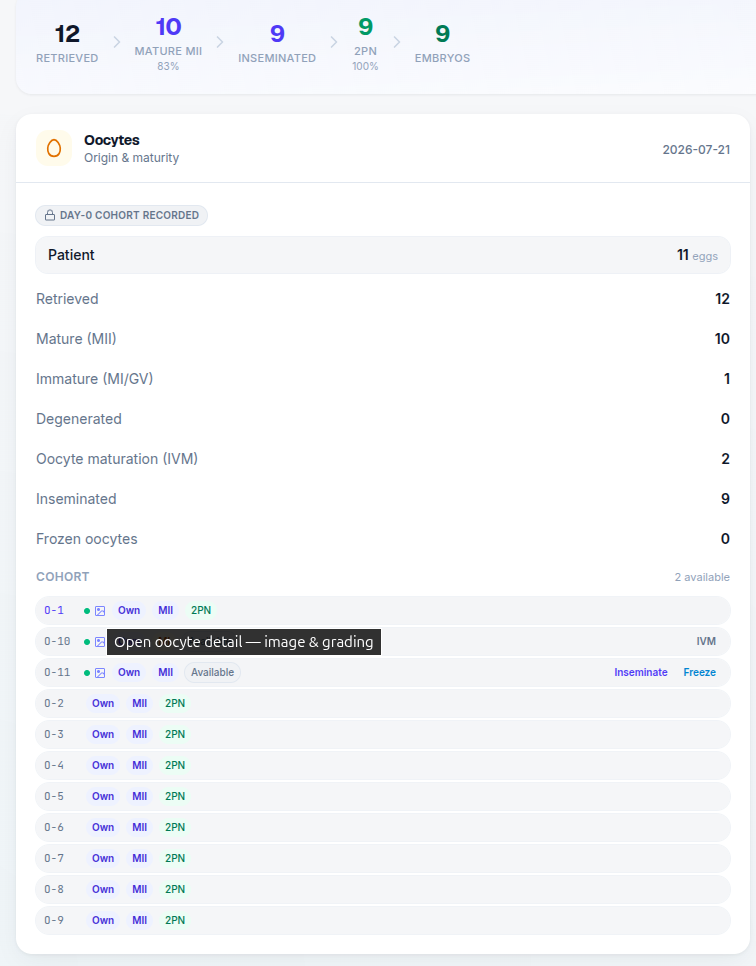
The day-0 cohort recorded oocyte by oocyte, with the funnel from retrieval through fertilisation derived from the record rather than typed in.
AI that belongs to the lab
EMBRY's assessment pipeline runs through standard inference frameworks rather than a sealed proprietary engine. A clinic can register a remote model or supply its own, and the platform will run it. The architecture treats the model as something the lab holds, not something the lab rents.
Alongside it sits EmbryLab — a labeling studio where a clinic annotates its own images, builds a dataset from its own cases, and trains when there is enough data behind a given label to justify it.
Time-lapse that arrives on its own
Your time-lapse system already saves its recordings and metadata somewhere on the clinic network. EMBRY reads from that location directly. Switch on the auto-sync watcher, set an interval, and new recordings are imported and matched to the correct patient and cycle without anyone touching a file browser.
Anything ambiguous is parked for human review rather than guessed at. A recording attached to the wrong cycle is a worse outcome than a recording that waits ten minutes for a person to confirm it.
Your server, your data, your language
The platform runs on the clinic's own server, inside the clinic. Media is served through authenticated endpoints rather than public URLs. Heavy AI and video work runs on a background worker tier so the interface stays responsive. Backups fan out to local, on-site, and off-site targets with encryption at rest.
The interface and generated reports are fully localised in English and Italian, and new locales are a configuration change rather than a development project.
What this means for your clinic
One system for the lab, the schedule, the AI, the reports, and the patient — instead of four systems and a folder of exports.
The embryo record becomes complete and auditable, with deliberate empty values distinguished from missing ones.
Time-lapse import stops being a daily manual task.
Your data and your models stay on infrastructure you control.
If you'd like to see how this maps onto the way your lab already works, book a demo and we'll walk through it with your workflow, not a generic one.
Comments