
Automating the IVF Report
How EMBRY pre-fills each development day from time-lapse video, keeps the embryologist as the decision-maker, and generates the clinical report from one structured record.
- AI
- Embryology
- Workflow
- Reports

An embryology lab records the same embryo several times over. The grade is observed at the microscope or on the time-lapse screen, written into a lab sheet, typed into the clinic system, and then typed again into the report that goes to the clinician and the patient. Each copy is a chance for a transcription error, and none of them adds clinical information.
EMBRY is built around a different sequence. The AI proposes the values for each development day. The embryologist confirms or corrects them. Everything lands in one structured record, and the report is generated from that record rather than rewritten from it.
Step one: the AI pre-fills each development day
EMBRY imports EmbryoScope time-lapse exports from the clinic’s network storage on a schedule and matches each recording to the right patient and cycle. Anything it cannot match with confidence is held for a person to review instead of being attached to a guess.
With AI assist switched on, the recording is analysed day by day, and the fields that matter on each day are filled in:
- Day 1: pronuclei.
- Days 2–3: cell count, fragmentation and symmetry.
- Day 4: compaction.
- Days 5–6: Gardner expansion, inner cell mass and trophectoderm.
The analysis does not rest on one image. EMBRY picks the sharpest frame for each day and takes a vote across that day’s frames, and every value it proposes carries a confidence level. Where the model has nothing to offer for a field, the panel says so and leaves it empty rather than filling the gap.
Step two: the embryologist confirms or corrects
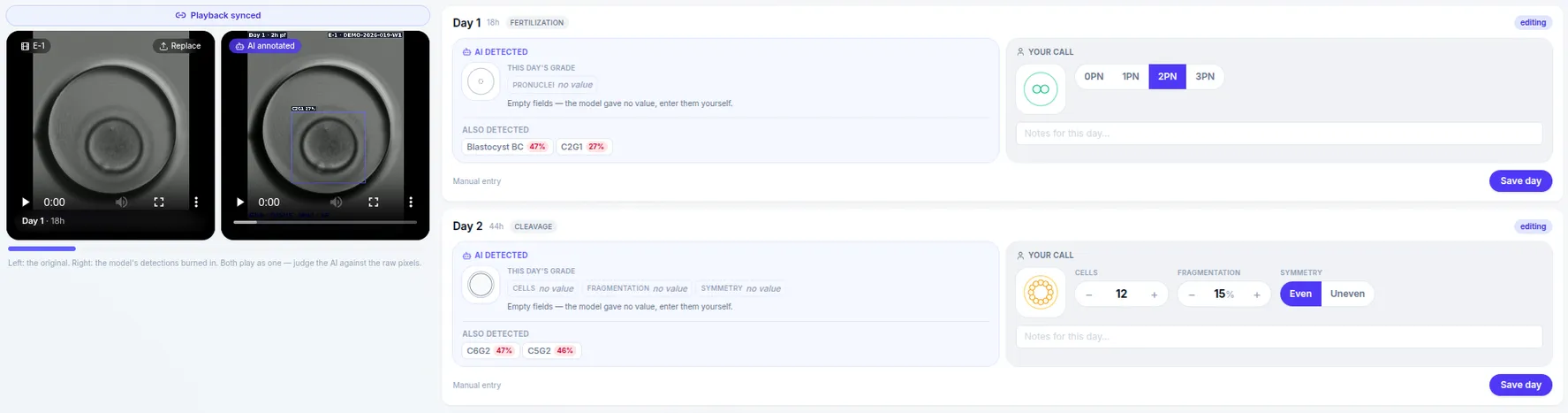
Each day shows what the model detected next to the embryologist’s call, with the video alongside so the AI can be checked against the raw images.
The review board puts two columns side by side for every day. AI detected shows what the model proposed and how confident it was. Your call is the embryologist’s entry, and it is always editable. Each field shows where it stands: a suggestion not yet reviewed, a value that matches the AI, or one that differs from it. At the top of the board, running counts show how many days are confirmed, how many were corrected, and how often the embryologist agreed with the AI.
Nothing is accepted on the embryologist’s behalf. Confirming means reviewing the day and saving a value, whether that value keeps the AI’s proposal or replaces it. The AI can also be switched off entirely, in which case the column disappears and the embryologist enters every value, as before.
The point is not to take the decision away from the person accountable for it. It is to remove the blank form, so the embryologist’s time goes into judging the embryo rather than transcribing it.
Corrections teach the clinic’s own model
Every correction is information. When an embryologist saves a value, it becomes a labelled example in EmbryLab, attached to the sharpest frame for that day. Over time, the clinic accumulates a dataset graded by its own staff, to its own conventions, and can train its own model on it.
That changes what the AI suggestions converge towards: not a pooled standard from somewhere else, but the way this lab grades. We wrote about why that matters in Whose AI Is It Anyway?.
One record from start to finish
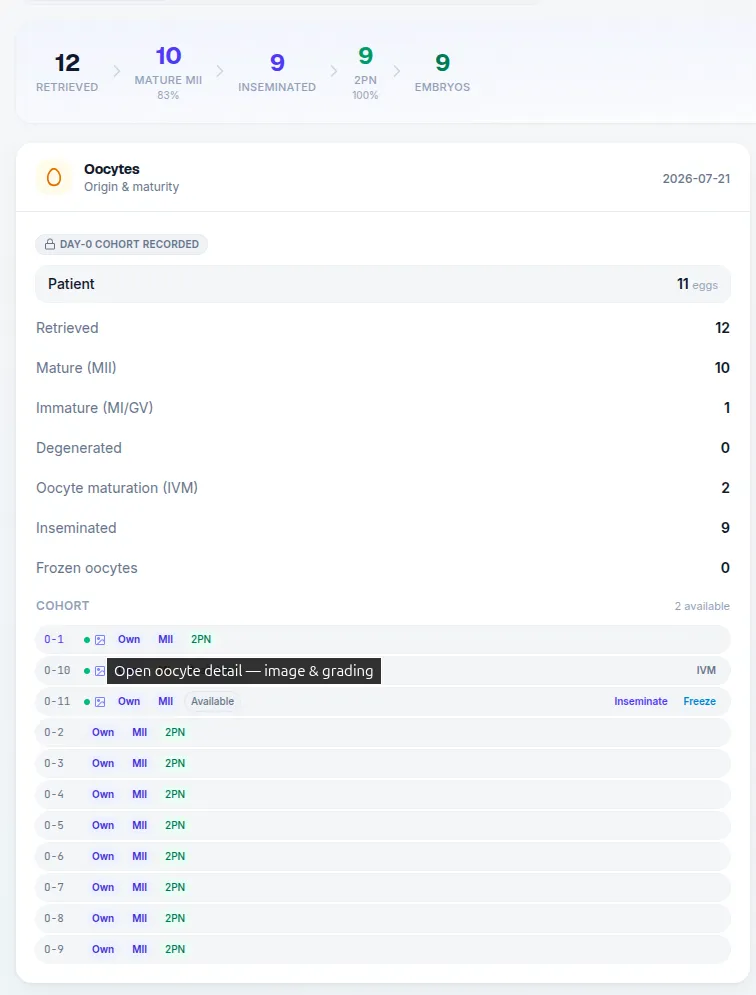
The day-0 cohort recorded oocyte by oocyte. The embryos that follow are created from this record, not entered separately.
The development board is one stage of a single digital record that carries the case through the clinic:
- the case and the cycle;
- oocyte retrieval, with each egg graded individually;
- fertilization, where each 2PN oocyte becomes an embryo in the record;
- the day-by-day development board described above;
- freezing and thawing;
- transfer;
- and the outcome.
Each stage builds on the data entered at the one before. An embryo’s history is not reconstructed from several systems when someone needs it; it is already in one place, in a structured form.
Step three: the report is generated from the record
Because the data is already structured, the clinical report does not have to be written. The embryologist or clinician chooses a template, such as Cycle, Fertilization, Transfer or Patient Summary, and the report is generated in one click from the recorded data, as a PDF in English or Italian.
No value is re-typed on the way. The grade in the report is the grade the embryologist saved on the board. Once reviewed, a report can be published to the patient portal, where the clinic has it enabled, so the patient receives it without it being sent as an email attachment.
What this means for your clinic
- The AI does the first pass on each development day; your embryologists review and decide.
- Every AI proposal sits next to the embryologist’s call, so agreement and correction are visible, not hidden.
- Your embryologists’ saved grades become training data for a model that learns your lab’s conventions.
- One structured record runs from retrieval to outcome, instead of separate lab sheets, databases and documents.
- Reports are generated in one click from that record, without re-entering data.
If you would like to see how this workflow fits your lab, talk to our team.